
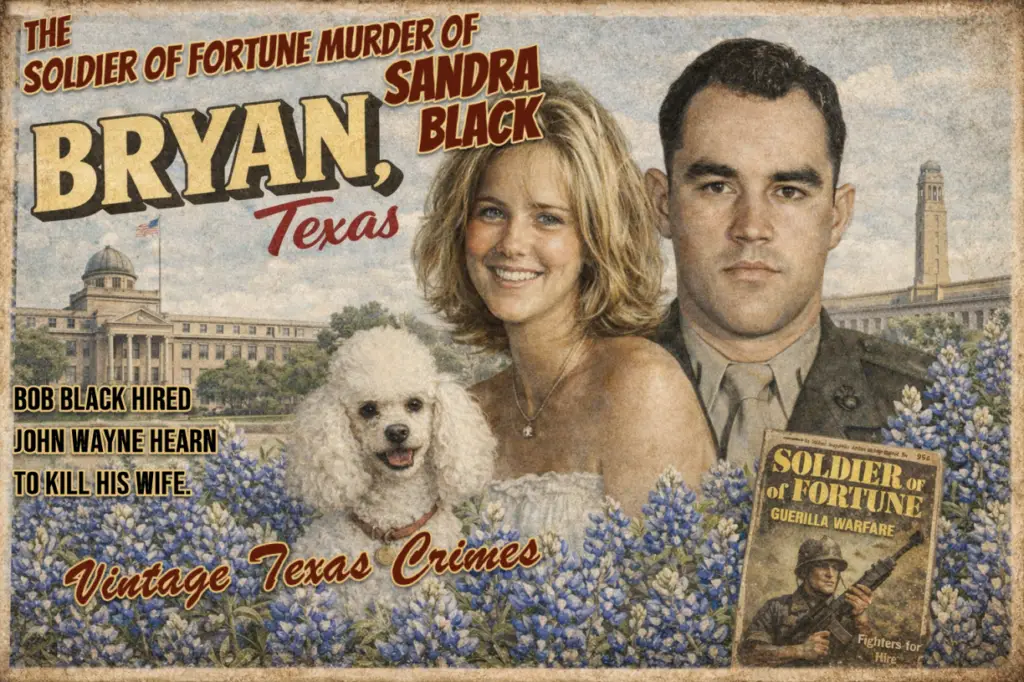
1985 | Bryan, Texas | Sandra Black’s Murder
Warning: If you are triggered by acts of domestic violence, skip this one.
PART I
The Crime
On the quiet evening of February 21, 1985, Robert Vannoy (Bob) Black Jr., and his 15-year-old son, Gary, pulled up to their home on Steep Hollow Circle, east of Bryan, Texas. Gary wasn’t feeling well that day. He had a fever and sore throat; his brain was zoned in on getting into bed as soon as possible.
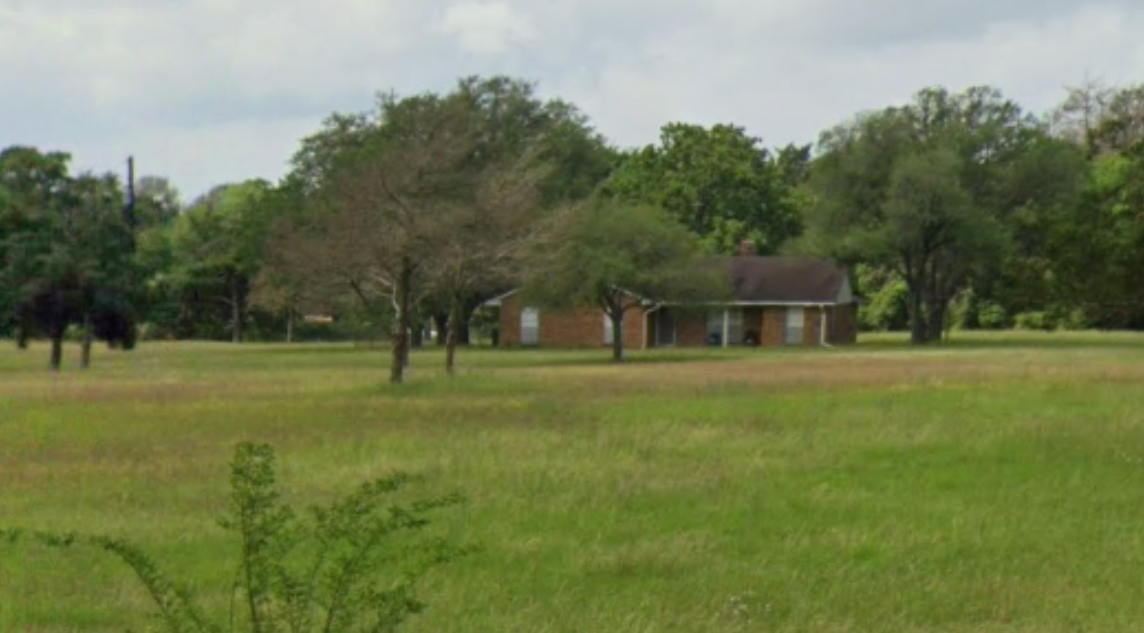
The House on Steep Hollow
As soon as he took two steps inside the door, he knew that something was off. He saw his mother’s purse on the buffet.
“Mom?” called Gary.
As soon as it was out of his mouth, Gary saw his 36-year-old mother on the floor, lying on her back between the kitchen entrance and the table where she had served their meals for the last eight years.
“Mom!”
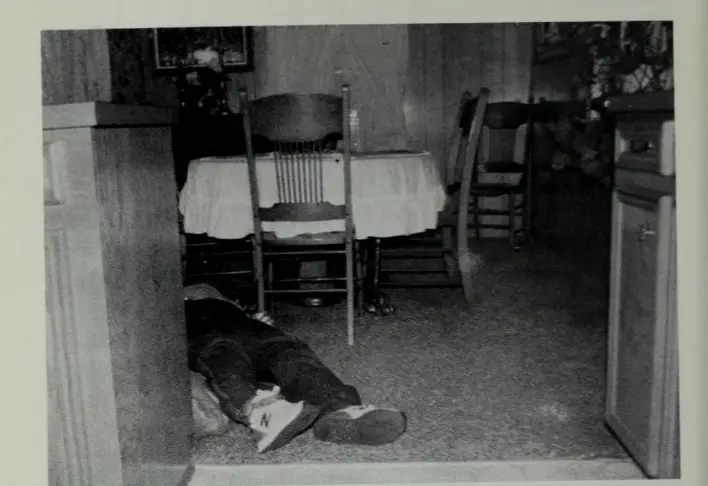
Where Gary Found His Mother
He ran to her and touched her shoulder; that’s when he saw the blood around her head and the shot between her eyes.
His father was still outside. Gary stood and backed away so quickly that he almost fell. He ran out the door and found Bob. He told him about his mother and Bob took over.
From there, everything around Gary Black moved lightning-fast while he could barely move at all.
Hardly any time passed before two deputies from the Brazos County Sheriff’s Department swarmed through the home with their pistols in their hands, ensuring Sandra Black’s attacker had left. When they had cleared each room of the house, they went out to ask questions.
Bob Black told them his wife’s van was missing from the driveway. Already, there were more cars and more flashing lights.
Gary was aware of his mother’s body coming out of the house in a bag; they loaded her into an ambulance. He heard someone say something about an autopsy, and he felt weak. Yellow tape went up, blocking the entrances to their driveway and home; a bulletin was issued to be on the lookout for the van normally driven by Sandra Black.
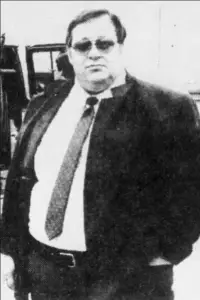
Sheriff Ron Miller
Sheriff Ronnie Miller walked through the house, noting the chaotic scene of overturned furniture and ransacked rooms. To an untrained eye, the maze of mess looked like the aftermath of a burglary gone wrong. But Sheriff Miller and his investigators recognized the rooms for what they were—ridiculously theatrical, like the high school had sent over a couple of drama students to stage a scene for a play. Sandra Black had been shot from behind, one to the back of her head and near her ear. A second shot was delivered as the attacker stood over her.
How did the intruder get to the scene without a vehicle? The killer must have been on foot since he or she (or maybe more than one) stole Sandra Black’s van to leave the crime scene. Could someone have dropped the intruder off at the house?
Sheriff Miller didn’t believe this was a random act of violence; in fact, he and his investigators, Charlie Owen and Chris Kirk, didn’t miss the husband’s contrived crying spell that came on when he noticed neighbors gathered in the street. The more the Brazos County sheriff learned about Bob Black, the more he and his team were convinced that the victim’s husband was involved in her murder.
——————————————————————————–
Hi there!
It’s Brenda with Vintage Texas Crimes. This is a long one that happened forty years ago in the Bryan-College Station area. A quick shout-out to “Ronda,” who told me about this story last summer.
I had heard nothing about it before she told me.
The Eagle (local newspaper) produced articles on the case which were helpful, but the book I relied on as a source was “The Soldier of Fortune Murders by Ben Green.” If this story tickles your fancy, read the book. It’s excellent, and there’s so much more to this story than I could include here.
——————————————————————————–
A Miserable Marriage
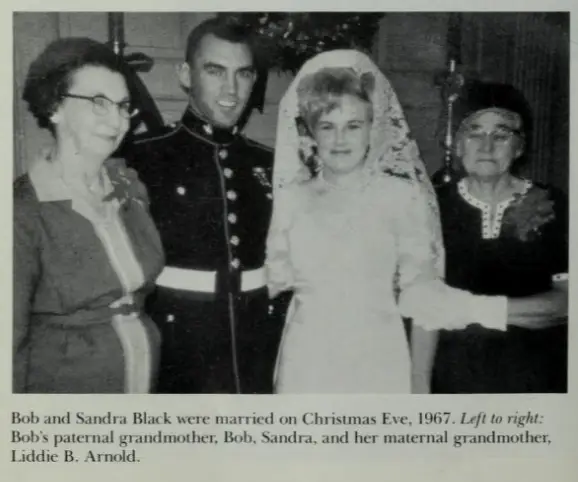
1967 Wedding Photo of Bob and Sandra with their grandmothers
Robert and Sandra Black’s relationship was a testament to dysfunction, a cycle of turmoil, divorce, and dangerous reconciliation. They first got married in December 1967, and Sandra divorced him on January 7, 1974. She remarried Bob on December 18, 1975, and at the time she was killed on February 21, 1985, she had a divorce petition on file again.
This rocky relationship took off when Sandra met Bob at a picnic-mixer for Texas A&M Corps of Cadets to meet girls, since there were only a few attending the university. It was the spring of 1967. Sandra had been out of high school for a year and taking college courses at Allen Academy, while working full time as the head bookkeeper at Briarcrest Country Club.
Bob was a sophomore at Texas A&M University and two years older than Sandra. He love-bombed Sandra, wrote poems for her, and gave her flowers. She fell hard for him. Two years into his education, Bob was struggling to keep his grades up. He had been put on scholastic probation, but he took summer classes and brought his grades up to maintain his place at the university. The hardcore curriculum at Texas A&M was stressful on a young man who had made near-perfect grades at Haskell High School in his hometown of the same name, fifty-five miles south of Abilene.
Just being an average student with mediocre, almost failing grades at Texas A&M was not to Bob’s liking. The Vietnam War was heating up, and young men not in college were being drafted. Bob had a student deferment because he was in school, but if he began failing, he would lose his deferment and be drafted. Then everyone would know he had flunked out.
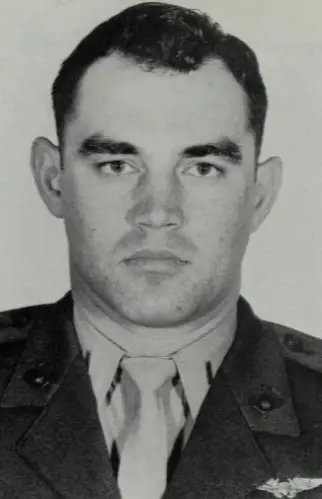
Bob in 1967
Bob figured out that he could be a gallant hero who left college to go fight for his country, and that way, he was no longer on a path to inevitable failure. So without talking to Sandra or anyone else, Bob did not register for school in the fall of 1967. Instead, he enlisted in the U.S. Marine Corps and was shipped out in October 1967 for boot camp. When he came back in December, he convinced Sandra Eimann to marry him.
Sandra’s mother, Marjorie Arnold Eimann, did not care for Bob from the beginning. But she and Sandra’s father, Glen Eimann, resigned themselves to accepting the marriage.
Sandra visited her new husband in California, taking along her white poodle, Tramp, on the cross-country drive. Bob came home for Gary’s birth in the fall of 1969. In 1970, he was stationed in Hawaii. Sandra and little Gary joined him; they lived their happiest twenty months of their marriage in Hawaii. Bob was then shipped off to Vietnam, where eventually he became a flight officer. He could not be a pilot because his eyesight was not 20/20, so he had to be happy sitting behind the pilot, focused on the mission and the equipment, and being a second set of eyes.
Sandra packed up Gary and they went back to Texas while Bob was in Vietnam.
After six years in the Marines, and flying in more than 100 combat missions in the Vietnam War, Bob came back to the Bryan-College Station area on leave in the summer of 1973. The Vietnam War would not be officially over until 1975, but all involvement by the U.S. was over in March 1973.
That left the U.S. Marine Corps replete with officers on the payroll and little for them to do that matched their ranks. It was time to reduce the force.
While on leave, with no warning, Bob received a letter from the U.S. Marine Corps. They sent him a check for $10,000, placed him on reserve status, thanked him for his service, and informed him that he was no longer needed full-time.
Bob was horribly disappointed. His world fell apart when he got the letter.
Bob suffered when he didn’t feel special. He was an average-looking man, and some women thought his dark looks were handsome. Bob was 5’7” and thirty pounds overweight, and he hounded his wife constantly about her weight after he was out of the service. His position as flight officer in the Marines had helped him to feel okay about not being tall, but with military life gone, he loathed himself and made his family pay for it. Bob Black was controlling and demanding; he exploded in anger about any little thing.
The Vietnam vet had felt like he a hero when he was a Marine. In Bryan, he was just another unemployed college dropout looking for a job, and when he got one, he never kept it long before he quit or was fired.
When he became frustrated while using tools, he would throw them, or strike nearby objects. He broke glass and windows during his tantrums. Friends and family said they knew he had hit Sandra and that Gary hid from his father when he was angry.
Without Bob making an income, Sandra—always the one to find work and bring in money—had been working as the distributor for Houston newspapers in Bryan. She was financially stable. Sandra finally got enough of his nutty behavior filed for divorce. She did so after Bob took off and stayed gone for three weeks before letting Sandra know where he was.
His behavior had become intolerable; he wouldn’t stay with a job, and Sandra knew he was cheating on her. The divorce was finalized in January 1974 and they lived apart.
Bob still had not worked when the summer of 1974 arrived. He went to his high school reunion in Haskell, Texas where he ran into a friend from high school who helped him get a job in the Midland oilfields. Working as a laborer for an oil company, Bob finally applied himself.
——————————————————————————–
PART II
Midland

Adobe Image of Oil Wells
Within a few months at the new job, he had shown he was a valuable employee, and Bob was promoted to a white-collar job with the company as a field supervisor. With the promotion came a company car. Early in 1975, he began trying to convince Sandra, who was living on her own and doing fine, to sell the home they had bought in College Station and join him.
It had been just long enough that it seemed he would keep his job, which was a good-paying one. It was also long enough since her last scare from Bob that Sandra could put it out of her mind and reconcile with him. So Sandra moved to Midland, where they bought a house.
And wouldn’t you know it? Bob was soon having trouble on the job. He was dressing like a slob, showing up to meetings in t-shirts and jeans, and smelling of beer. He was not staying focused on his work, and it wasn’t getting done.
On Thanksgiving night in 1975, after enjoying a Sandra’s homecooked turkey dinner, they watched the Aggies play the Longhorns. Later that evening, the Blacks went to bed just like they always did. Sandra woke up about 3 a.m., and Bob was gone again. Of course, when he came back a couple of weeks later, he no longer had a job. But somehow, as soon as he got back, he talked Sandra into marrying him again, which they did on December 18, 1974.
Sandra did not have a job in Midland because she and Bob agreed she would stay home. Neither of them could find work, and by February, they couldn’t pay their house payment or their bills. They scraped together enough money to put gas in their car and head back to Brazos County. They would move in with Sandra’s parents, on Winding Road in College Station.
————————————————–
TRIGGER WARNING: There are frequent graphic references to violence and dangerous domestic situations from this point forward.
————————————————–
Red Flags

Many red flags waving in a field at sunset
Once he was back in the Bryan-College Station area, Bob did not even try to get a job.
Meanwhile, while Bob was wallowing in self-pity, Sandra and her mother converted a rental house Marjorie owned next door to her house into “Happy Face Daycare.” Their license allowed them to have 31 children at a time. The daycare was located near the intersection of Holleman and Winding Road. It was near enough to Texas A&M University that it was full all the time.
Thanks to Sandra, her family’s income grew from 1976 forward. In fact, she was earning $36,000 in 1984, which was like having a $112,000 annual income in 2026.
Sandra was the breadwinner ninety-five percent of the time. It is hard to understand why Sandra Black stayed with Bob, but that’s not said to criticize. As a society, we have learned that leaving is challenging for most women in these types of relationships. Sandra Black’s life is a cautionary tale. If a man does the things Bob Black did–which we are about to get into–the wife needs to get out as soon as soon as possible.
One big reason Sandra didn’t leave was that Gary idolized his father, and as he got older, he begged his mother to stay with Bob and give him another chance. A court document I found said that Bob Black frequently tried to take his own life. I don’t believe he really wanted to die during those events; he did it to keep Sandra around. Sandra always relented and stayed with him when he would take a handful of pills to end it all. But he never took enough to really hurt himself. Sandra, however, was convinced that he would kill himself.
Along the way, there were countless red flags that pointed out the danger she and Gary were in. It’s hard to judge which is the worst, so I’ll just give you three. There was the horrific day he shot Sandra’s little poodle, Tramp. She had had Tramp since before she had met Bob.
Sandra and Gary, then seven years old, screamed at him to stop when he got his g*n and k*lled the little dog, all because he was barking at a salamander Bob had put in a bucket.
Prior to that, there had been a huge red flag that came when they were trying to buy the house on Steep Hollow Road. They needed $10,000 as a down payment, and they could assume the loan. It was a nice house that needed a lot of fixing up, but it was the perfect deal for them since it was the only way they could get a loan because of credit problems they had in Midland.
They were living at Sandra’s mother’s home, and Bob wanted Marjorie to loan them $10,000. Marjorie Eimann told him, “I don’t have that kind of money, Bob.”
Sandra said, “Bob, my mother doesn’t have an extra $10,000 to loan us.”
Without warning, Bob sprang at Sandra, grabbed her, and threw her across the living room and into the screen door. The door gave way and broke open, spilling Sandra onto the concrete porch. She didn’t break any bones, but she was bruised up from head to toe. Bob took off and stayed gone for a couple of weeks. When he came back, Sandra’s bruises were still there, but she took him back.
Bob’s family loaned them the $10,000 for the home and six acres on Steep Hollow Circle, and they turned it into a dream home. There was plenty of room to enjoy their lives; even so, the good life was not enough for Bob. He pitched fits regularly, got mad at the drop of a hat, and caused Gary and Sandra to walk on eggshells.
Also in 1976, Bob became angry at Marjorie Eimann because she came over when her daughter called. Bob had just stormed out during one of his tantrums. Marjorie drove up the long driveway to their house and went inside to console Sandra.
Bob came back sooner than he usually did, and Marjorie was still there.
Marjorie didn’t want to see him. As he was coming in the back door, Marjorie zipped out the front. Bob went into the bedroom and grabbed one of his guns. Sandra saw what he planned to do, and she tried unsuccessfully to wrestle the gun away from him.
Bob chased Marjorie in his car. At one point, Marjorie said she was driving 90 miles per hour on FM 1179, and she turned into her brother’s driveway and drove around his house. She had enough of a lead so that Bob didn’t see her, and she hid out there all day long.
After that, Sandra insisted he go into the hospital for treatment. He entered Greenleaf, a local psychiatric hospital. The doctor said he had a-typical depression and put him on Triavil, which helped. When he got out of the hospital, he came home and went to work as a residential electrician. He liked the work and was good at it. Homeowners praised him to the companies he worked for. He wasn’t steady at any job.
Bob would work for first one company and then another, never staying long, but at least he did seem to like electrical work. In 1983, he went to work for the post office. He held the job for over a year, but quit without explanation after he had been there for fourteen months.
Their lives were one big blur of Bob Black’s shenanigans, blow ups, anger problems, job losses, new jobs, psychiatrists, broken windows, Bob running off for a few weeks, and Sandra trying to get him to take his medication.
In July 1984, Sandra filed for divorce again, the legal petition citing “cruel treatment toward petitioner of a nature that renders further living together.”
Inexplicably, the couple reconciled once more. The divorce case was dropped in December 1984. Two months later, Sandra was dead.
——————————————————————————–
PART III
A Catalyst Named “Teresa”
As far back as 1982, Black had talked about killing his wife. He offered a man named Mark Huber $5,000 to kill Sandra, even paying a $500 down payment. Huber took the money but had no intention of carrying out the act.
For Bob Black, killing his wife was not a sudden impulse but a boiling obsession. For years, he shopped a chilling litany of murder plots to anyone who would listen; it was a persistent and escalating campaign of premeditation.
Oddly, Black thought no one would talk about his proposals of murder, showing how out of touch with reality he actually was.
But the real catalyst for ending Sandra’s life came when Bob Black met Teresa in April 1984. ( I’m leaving off her last name.) She was his first cousin, his uncle’s daughter, and she lived in California. Bob had not seen her since she was a little girl. He attended a spring family gathering in Houston, and Teresa was there. Bob was instantly obsessed. He was 38 and Teresa was ten years younger than Bob. He decided right away that he wanted to marry her.
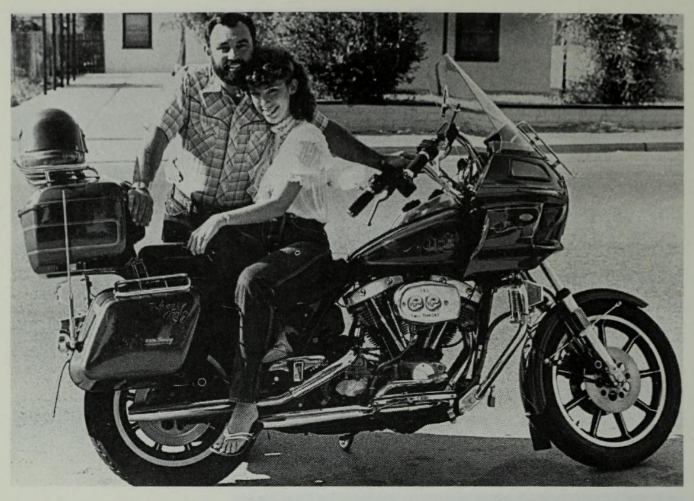
Cousin Teresa and Bob Black
That night, he took Teresa to Gilley’s, a dancehall in Pasadena. Before she went back to California, Robert and Teresa were kissing cousins. Bob Black’s desire to kill his wife was thus fueled anew; being with Teresa was all he could think about. Sandra was in their way.
Teresa’s husband was also in the way, but for some reason, Bob Black considered him less of an inconvenience than his wife. He was dead focused on ridding himself of Sandra Black, and divorce was not an option. Without Sandra, he had no income, unless he could cash in on an insurance payout.
He began laying out his gruesome death plot scenarios to Mark Huber’s brother, David Huber. David declined to help.
In January 1985, he approached his supervisor, Gordon Matheson, with yet another scheme: crash Sandra’s van with her inside. If the impact didn’t kill her, Black chillingly added, he could “beat her in the head with a club.”
None of these men took Black seriously or went to the police. Matheson thought Black was merely fantasizing. David Huber, who was absent without leave from the Marine Corps, feared he would be arrested if he came forward. And so, Bob Black’s murderous plotting continued; he ruminated about killing Sandra constantly.
The Soldier of Fortune Connection
When his local contacts proved unwilling, Bob Black cast a wider net. In October 1984, his search led him to the classifieds of Soldier of Fortune magazine, where he found an ad for the World Security Group.

Soldier of Fortune Magazine
Black called the number, and a man who said he was John Wayne Hearn called him back. Black told Hearn he wanted to work for the World Security Group. Hearn responded that he would get back with him if something came open.
After that, they talked about being Marines in the Vietnam War. The two men met in person on January 9, 1985. Hearn, a fellow Marine veteran, wanted to buy Bob Black’s gun collection to arm the Contras in Nicaragua. He flew in from Gainesville, Florida, and was looking at the firearms. Bob quoted a price that was $1,000 higher than he had told Hearn on the phone.
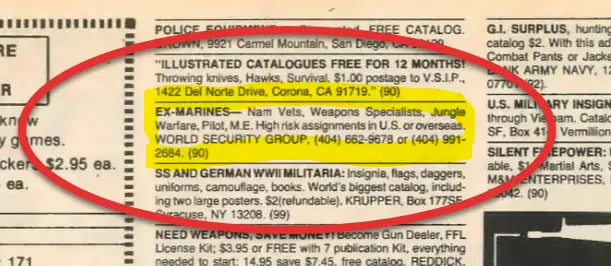
Ad in the Soldier of Fortune Magazine. Bob had circled an ad like this.
That angered Hearn. While they were negotiating over that, Black revealed his true agenda. As Hearn would later reveal, Black casually remarked that he “would have all the money he needed if he did not have a wife.”
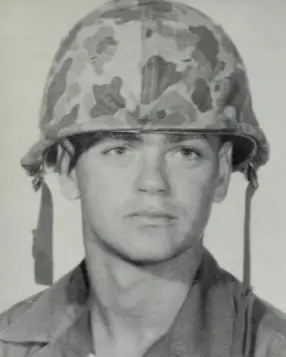
John Wayne Hearn
Black asked him if he wanted to eliminate his wife for him.
Hearn refused to kill Sandra Black and told Black he owed him $1,000 for expenses for getting him to come to Bryan on false pretenses. He would not be back without receiving a payment for that.
The $10,000 Contract
Black asked his friends again about eliminating Sandra, but there were no takers. Black called Hearn again. This time, there was no pretense. He formally offered Hearn the contract. Hearn’s girlfriend, a woman named Debbie Banister, wanted him to do it, because they needed the money, so he agreed.
The price for Sandra Black’s life was set at $10,000, plus $1,000 for expenses.
Bob had talked Sandra into increasing her insurance policy in late January 1985, and she took out an additional $100,000 life insurance policy payable to him. The total insurance on Sandra’s life was then $150,000. (That’s like $450,000 today.) The policy became effective on February 13, just eight days before her death.
Still Obsessed with Cousin Teresa
During this time, Bob Black is still obsessed with his cousin. So MUCH goes on there, but if I added that trainwreck to our story, it would be novella length! Ben Green’s book tells all, if you want those details.
Sandra’s Death Day
On the afternoon of February 21, 1985, Black and John Wayne Hearn met in the Safeway parking lot on Briarcrest in Bryan. Black drove Hearn to the residence on Steep Hollow Circle. Inside the empty house, he gave Hearn pieces of Sandra’s best gold jewelry as collateral for the final payment, which would be paid after her insurance policy paid Bob.
Bob also gave Hearn a .22-caliber pistol.
“He handed it to me and said, ‘Use this one, it’s my wife’s,’” Hearn later testified. Together, they ransacked the home to stage a fake burglary.
At 5:00 p.m., Black made his alibi call, phoning Sandra at the daycare center to confirm her arrival time at home. His trap set, he left to pick up their son, Gary, who had spent the day at Marjorie’s house because he was sick. Bob intended to run errands until after the deed was done.
Hearn waited alone in the darkening house. At approximately 6:40 p.m., headlights cut through the twilight as Sandra pulled her van into the driveway. She entered the house, and Hearn stepped from the shadows.
He later claimed he did not remember firing the two shots that killed her, only seeing her van’s lights come on as he drove away in it. He shot her behind the left ear and she dropped, but was still alive. Maybe he realized she might not die, because he shot her again in the the left eye. A pathologist would later testify that Sandra lived for five to eight agonizing minutes after being shot.
Hearn drove Sandra’s van back to the Safeway lot, abandoned it, and retrieved his rental car. He drove to Houston, heading for Intercontinental Airport (now known as George Bush Airport). On the way, he threw the murder weapon into Lake Conroe.
Two days later, a Bryan police officer discovered Sandra’s van and radioed BCSO. Sheriff Ron Miller wasted no time getting to the Safeway parking lot on Briarcrest.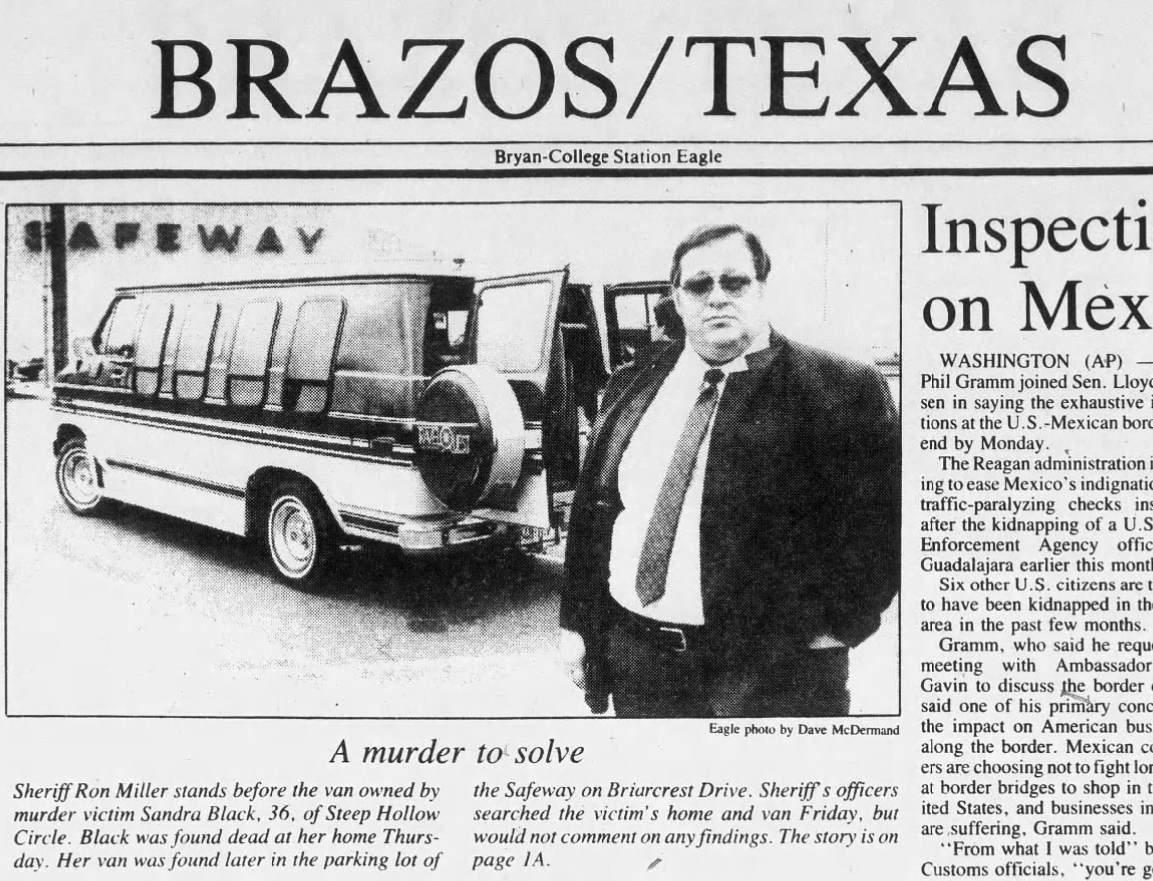
PART IV
The Investigation
There were plenty of clues to tip off the investigators from the Brazos County Sheriff’s Department about what had really happened.
Right away, Sheriff Ronnie Miller noticed Robert Black did not show genuine regret about his wife’s death. The sheriff’s department got a search warrant immediately to look for evidence that might help them solve the crime. After making a discovery, they stopped the search and got another search warrant, one that was specifically to look for evidence against Bob Black.
They kept the house away from Bob for eight days and kept it under surveillance while Chris Kirk sifted and combed through the home. He and his team carefully catalogued and bagged evidence for eight straight days, working way into the nights. During that time, Bob and his parents stayed at the E-Z Travel Inn on Texas Avenue.
Bob put on a Oscar-winning performance during Sandra’s funeral, first styling and organizing all the flowers by color, having a professional record the funeral with a camcorder, and then the grand finale: weeping and lying across the top of her casket once it was closed.
After Sandra’s death, people began dropping by the Sheriff’s department, providing their thoughts. Bill Arnold and Margaret Mauro, Marjorie’s siblings (also Sandra’s uncle and aunt), told law enforcement about Robert Black’s violent nature and how he had increased the amount of life insurance he had on Sandra just two months earlier. Insurance agent Don Ballard confirmed this to be true.
Arnold and Mauro also told investigators about Bob having an affair with Teresa, his first cousin from California, and that Bob had taken her into a jewelry store to look at jewelry. He had introduced Teresa simply as his first cousin. Margaret Mauro was furious because the jewelry store belonged to her—and Bob did it right in front of her.
The discovery that made the sheriff go back for a second search warrant included a link between Bob and, possibly, a hitman. They found a copy of Soldier of Fortune magazine, with John Wayne Hearn’s advertisement circled in ink. It said:
Ex-Marines—Nam Vets, Weapons Specialists, Jungle Warfare, Pilot, M.E. High-risk assignments in U.S. or overseas. WORLD SECURITY GROUP, (404) 662-xxxx or (404) 991-xxxx.
Another ad they found circled mentioned “dirty work.”
The ads showed that Bob might have reached out to someone outside of the area, but that’s all the circled ads told them.
The BCSO investigators and the sheriff himself did not know who could have pulled the trigger for Black. After an informant within the biker community of Bryan called in a tip, plus an anonymous tipster called in, the investigators on Sandra’s case found out about four local men who Bob had offered to pay for eliminating Sandra Black: David Huber, Mark Huber, John-Boy Gorris, and Gordon Matheson.
After interviewing the men, the investigators were certain none of them had done it.
Two days after the murder, The Eagle threw Sheriff Miller way under the bus when they ran a picture of him by the van found where the killer had abandoned it, in the Safeway parking lot.
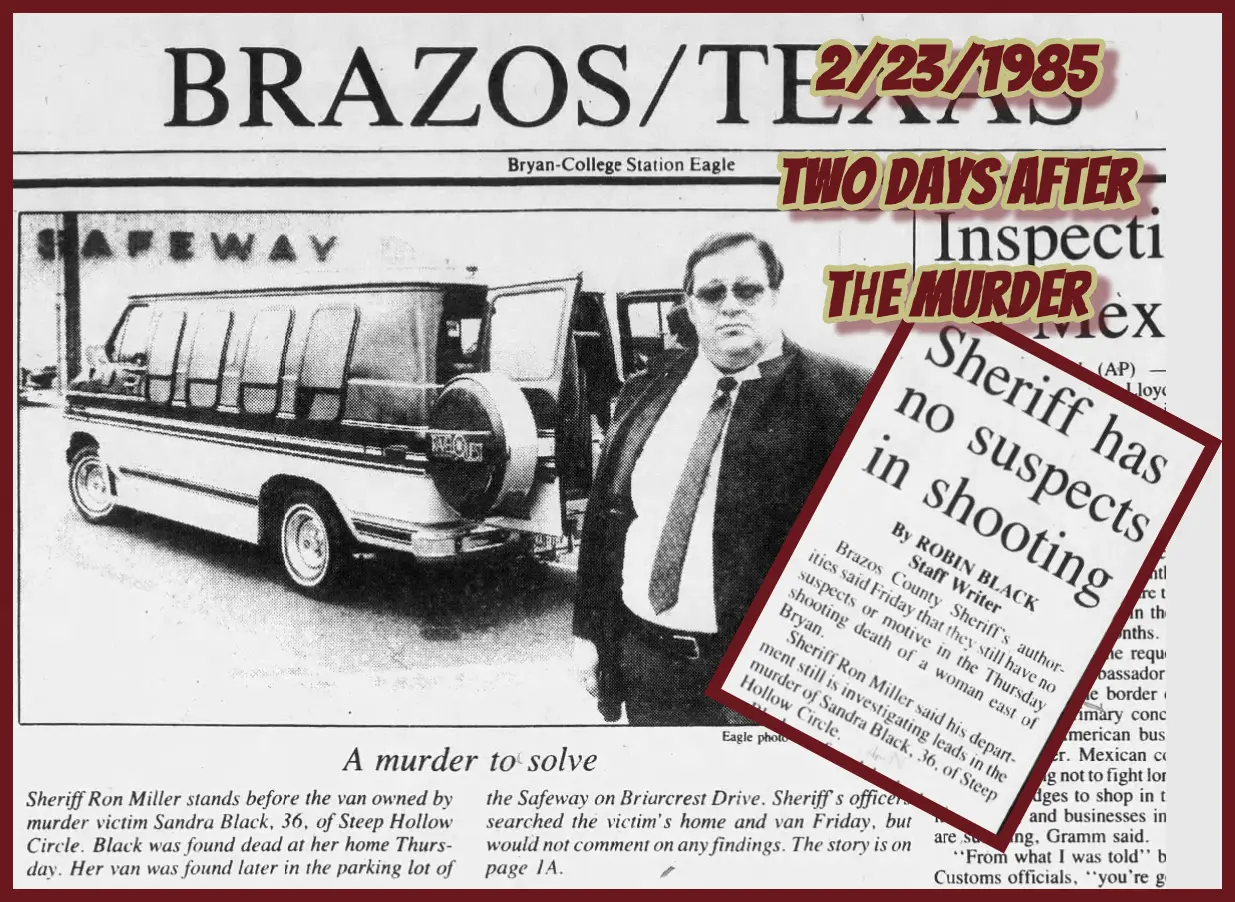
Two Days After the Murder of Sandra Black
It came with a headline of “Sheriff Has No Suspects in Shooting.”
The sheriff felt an intense pressure to solve the crime. His recent election victory was also being challenged at the time, and he really needed to bag Bob Black. Plus he just wanted to get the guy put away. Miller knew he was a dangerous man.
And then it was March 7, and Sheriff Miller received a terse call from Sandra’s family. They were going to hire a private investigator to start digging into the case. They wanted someone held accountable, and they figured Bob Black was involved. They were impatient and afraid to wait too much longer. Marjorie Eimann feared Bob would send someone for her, so he could have the daycare.
Miller had already been after District Attorney Bill Turner to work with him on the warrant to arrest Black, and Turner refused. The D.A. said the evidence just wasn’t there to convict Bob Black.
At the two-week mark, this was the evidence against Black:
• A Soldier of Fortune Magazine with ads circled.
• Four local men who said Bob had asked them to kill his wife.
• Evidence of a serious girlfriend. Found in the attic were: an envelope with pictures of the kissing cousins in everything-exposed positions of sex acts, forty-nine letters from Teresa in California to Bob’s secret post office box, and 52 letters from Bob to Teresa that she had returned to him when she was trying to break off the relationship.
• An increase in insurance from $50,000 to $150,000 on Sandra’s life.
• Weaponry in his closet showing he was probably a ticking timebomb, but not necessarily evidence for the case at hand. They had found hand grenades and other military explosives.
On March 8, the day after Sandra’s family told the sheriff they were going to get a private investigator, a phone call came in that broke open the case against Bob Black. Investigator Charlie Owen of the Brazos County Sheriff’s Office answered a call from a Florida police investigator who said his name was “Bear Bryan.”
Side note: If you are an Aggie of a certain age, you might be amused at how close the name is to another one. And if the name is of no significance to you, Coach Bear Bryant was a beloved football coach at Texas A&M from 1954 to 1957. If you don’t know about Coach Bryant, it won’t matter. You won’t miss anything in this story, but wow, what a coincidence.
The caller was Sgt. Bill “Bear” Bryan from Gainesville, Florida. He explained how he had called the Bryan Police Department asking them about a Bryan telephone number. He had been connected to Captain Gene Knowles, and Sgt. Bryan had asked him who the telephone number 409-822-xxxx belonged to.
Knowles looked it up in a reverse directory.
“That number belongs to a fellow named Robert V. Black, Jr. out on Steep Hollow Circle,” said the captain.
Bryan asked Knowles, “Do you have any recent unsolved murders there by any chance?”
“Well, yes we do,” said Knowles, “Black’s wife was murdered two weeks ago. But you need to call the Brazos County Sheriff’s Department—it’s their case.”
At 1:30 p.m. that Friday afternoon, Florida’s lawman Sgt. Bryan delivered some of the best news ever to burn through those old hard-wired telephone lines.
Bryan told Charlie Owen, “I think I’m going to help you solve a murder case over there today.”
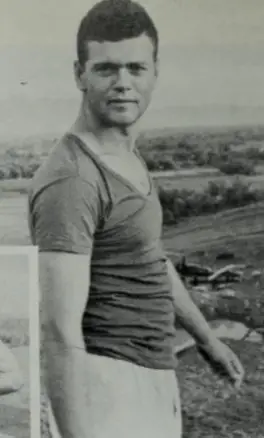
John Wayne Hearn
Charlie Owen got the Florida lowdown on a former Vietnam vet named John Wayne Hearn who was affiliated with an organization called “World Security Group.” Bryan told Owen that he and his team were sure Hearn had murdered two people in Florida while acting as a hitman, so he had been the subject of their investigation for a couple of months.
Sgt. Bryan explained how he had seen 409-822-xxxx on Hearn’s telephone bill and just wanted to see who Hearn was calling. He had just spoken with Captain Knowles at the Bryan Police Department, who said the number was Robert Black’s.
But the best was yet to come. The sergeant explained that Hearn’s dear mother, Mrs. Mary Watson in South Carolina had turned over an envelope to one of Bryan’s colleagues, and inside of that envelope was a copy of a letter from Mr. Bob Black in Bryan, Texas. With it was a copy of a cashier’s check for $1,000 from Bob Black to John Wayne Hern.
The handwritten letter said:
12:08 p.m. 85 Feb 14 Thurs CST
Skipper —
Here’s a cashier’s check and I have with me a personal money order for the same amount now.
My office number is 409-xxx-xxxx and I should be there from 0830 to 1200 Friday; at home shortly before and after; and leaving for Galveston/Houston around 3:00 p.m. If there is any way you could schedule your plans to coincide with my being alabied [sic] out-of-town this weekend, it would help considerably; first, I could easily take Gary Wayne with me for the weekend, whereas my being gone later in the week would put him riding with her at practically all times. Second, it will take some fast talk to arrange being gone from work as well as home on … probably Thursday.
No hard feelings if you can’t; I understand. Also, don’t want to push it down to the wire—23 Feb.
B.
Bob had sent the letter to Hearn via FedEx, and it arrived at Hearn’s mother’s home on February 15
Explanation of the letter’s contents:
• Bob was studying for his state insurance test and using an office at Don Ballard’s insurance agency to study in. That was what he referred to as “work” in the letter.
• The trip to Galveston/Houston was an insurance-related convention set for 2/15-2/17/85. Hearn did not go to Texas on those dates as Bob requested.
• The reference to “23 Feb.” probably means the date that Cousin Teresa’s divorce was going to be final, but I’m not sure why that would be “down to the wire.”
John Wayne Hearn’s mother had received the letter right after a visit from Florida investigators who were trying to find Hearn. She opened the letter, read it, and decided she needed to keep a photocopy of it and the check “just in case.” She had given the original to Hearn that night.
Florida investigators had called her in a few days later, asked if she had seen Hearn, and they grilled the tough old woman for hours. In fact, she stood up to them better than they could put up with her word salad and lies.
Finally, one of the detectives showed a picture of a woman to Hearn’s six-year-old son who was waiting in another room for his grandmother. The woman was Debra Banister, widow of one of the murder victims. The little boy told the detective that was his “new mama,” and he had been to Disney World with her and his new sisters a few days earlier.
Mary Watson knew she had to tell the truth, then. She told everything she knew and brought them the copies of the letter and the check. She also turned over many cassette tapes of recorded phone calls. Her son had put the recorder on her phone for his business, she said. She changed the tape when it was full.
That helped the Florida case immensely, but not completely. They still had some work to do.
But it had pretty much solved the case for Brazos County. BCSO grabbed up that ball and ran with it. They found out Hearn had been on an airplane to Houston from Gainesville the day before Sandra was killed. He had stayed at a motel in Navasota the night of February 20. The previous month, he had stayed one night at the Ponderosa Hotel on Highway 6 on the south side of College Station. Hearn had left on a flight out of Bush Airport to Gainesville on the same date that Sandra was killed.
D.A. Bill Turner said that was enough evidence for him, and a Brazos County judge signed two warrants. One for Bob Black, and one for John Wayne Hearn.
March 8 was a Friday. Miller found out that Bob had taken Gary to Houston for the weekend, so it was going to be two days before they could arrest him. They wanted to ensure Gary Black was safe and out of Bob’s reach before they let Bob know he was going to be charged.
On Sunday, March 10, Bob and Gary returned from Houston. Bob put Gary to work; he told him to use the gas-powered tiller and break up their garden. Gary wasn’t even halfway finished with the chore when his father appeared and told him to put the tiller up. A sheriff’s deputy had called, and they were going to the sheriff’s office to pick up Bob’s guns that had been taken into custody when the they had searched the house.
Robert V. Black, Jr. was directed into a back room where the BCSO deputies said he could sign the paperwork to collect his weapons; Gary was told to wait in another office. Sheriff Miller advised Black of his rights and told him he was being charged with Sandra’s murder.
Bob Black clammed up and refused to discuss anything. He had not been cooperating previously, so they expected this. They had asked him to submit to a polygraph so they could “clear” him the week after Sandra’s death, and he had refused.
After much back and forth with Sheriff Miller and the Florida lawmen, the hitman agreed to turn himself in, and five days later, on March 15, John Wayne Hearn surrendered, as agreed, to Texas authorities on I-45’s frontage road near Huntsville. Sheriff Miller had bet the Florida detectives he would not show and lost the bet.
The killer cried and carried on like a baby when he was arrested. But after he got himself pulled back together, he eventually told them the whole story, but not without a few lies leading the way.
John Wayne Hearn claimed he feared his own criminal organization would kill him if they learned he was a suspect. He also told him that principals from World Security Group had set him up. More lies about the non-existent organization came before he finally admitted that “World Security Group” was just a name in an advertisement.
A search of his truck uncovered pieces of Sandra Black’s jewelry in his briefcase—the collateral he had accepted as a down payment from Bob Black.
John Wayne Hearn Spills the Tea at Trial
At Black’s trial, the state’s star witness was the hitman himself. John Wayne Hearn, in exchange for a life sentence over execution, laid out the entire murder plot in damning, irrefutable detail.
David Huber, Gordon Matheson, and Mark Huber each took the stand to recount Black’s persistent solicitations.
Hearn told how he was a 39-year-old veteran of the Vietnam War when he placed an ad in the Soldier of Fortunate (SOF) Magazine. He had come home a war hero in 1970 with a box of medals: a Purple Heart, a Good Conduct medal, a Presidential Unit Citation, a Combat Action Medal, the Combat Action Insignia, and an Air Medal with seven strikes meaning that for each strike, his helicopter had received and returned fire during ten combat missions … so that would be at least 70 missions of immense danger.
Although undiagnosed, Hearn suffered from post-traumatic stress syndrome. If a car backfired, he reacted almost violently, nearly tearing off his mother’s front door trying to get out in the yard to look for a bunker. He lived desperately in 1970, always in fight-or-flight mode after his service in the Marines.
It had been an involuntary separation, he said. He hurt his knee while doing a long strength and endurance run, and that was the end of his service and his dream to be a helicopter pilot. Coming home, he learned how people in the U.S. treated vets poorly when they returned because of the horrible circumstances they had been forced to survive in during the war. It was a depressing time for him.
Before coming to Bryan, Texas, to kill Sandra Black in 1985, John Wayne Hearn had three bad marriages and a son who was six years old. Hearn had no direction; he drove trucks all over the U.S. and stayed broke most of the time after a divorce and bankruptcy ruined him.
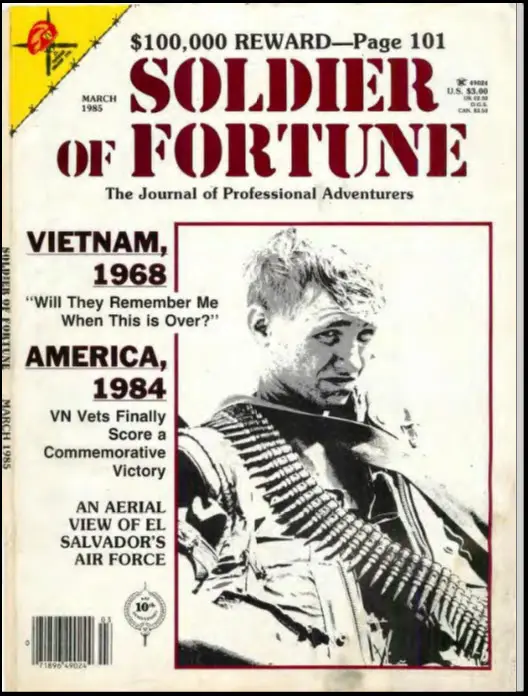
Soldier of Fortune Magazine
It was just a whim, he said about that advertisement he placed … he thought it might be exciting to be a bodyguard, so he placed ads with the Soldier of Fortune magazine. That was when all his problems began.
Hearn hoped he would get bodyguard work, and he also fanaticized about international spy-like gigs, but instead, most of the calls wanted their spouse or other family member killed. He ignored those … until a woman banker named Debra “Debbie” Banister called him from Florida and persuaded him to kill her brother-in-law for $10,000. She said it was for abusing her nephews, but it was really for the insurance money her sister would get.
He fell for Debbie, and soon, she wanted Hearn to eliminate her husband as well. So he did.

John Hearn and Debra Banister
Once Debbie was involved, she wanted to start a little murder-for-hire business. They began to consider murder-for-hire calls. That’s when the first call came in from Bob Black. Hearn flew to Texas and met Bob Black about Hearn buying his gun collection, but Bob raised the price when he got there. Hearn found out that Black wanted him to kill his wife; that was the real reason Black had lured him to Texas. Hearn had left angry.
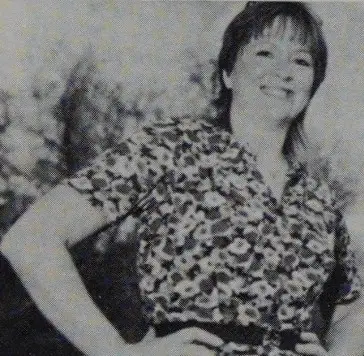
Debra Banister
Bob called again in early February, and Debbie spoke with him. Debbie encouraged Hearn to take the job. Hearn agreed to do it for $10,000, plus the $1,000 from the January trip and another $1,000 for the February trip. Black had to pay him in advance, which he did.
After Hearn finished Bob’s job, he and Debbie talked about marriage, and they took their kids to Disney World.
When they got back, Debbie found out Hearn was wanted for the murders in Florida. She told him to get lost; he was hurt and angry—after all, he had killed two men for her, plus he had done the job in Texas so she could collect $10,000 and pay off her bills.
She knew the cops were after him, but did not realize they were after her too. She told him they were done, with a capital “D.” She wasn’t going to lose her kids over him, and she sent him packing.
To save himself from execution, John Wayne Hearn negotiated three life sentences. He would not face the death penalty. In exchange, he would plead guilty to all three crimes and testify against Banister and her sister.
Of course, the well-established tape recorder at his mother’s house had Debbie saying things that incriminated her as well.
At the Black’s trial, his son, Gary, also testified, and so did Bob’s kissing cousin, Teresa.
She described how she had been trying to put a stop to their affair when Bob Black was finishing up plans with Hearn. During other testimony, it also came out that Bob was thinking about having Teresa’s husband killed, as well as Marjorie Eimann.
The last piece of the state’s case came from Don Ballard, a Bryan insurance agent. He told the jury that while driving with Black to Sandra’s funeral, Black had casually asked him if there would be any problem paying the claim on her life insurance policy.

Gary Cole played John Wayne Hearn in a 1993 CBS movie
Side note: A CBS two-part series came out based on this book in 1993. Gary Cole was perfectly cast in the role of John Wayne Hearn.
Guilty of Capital Murder
The jury found Robert Vannoy Black, Jr. guilty of capital murder. After answering affirmatively to the special issues of “deliberateness” and “future dangerousness,” they sentenced him to death.
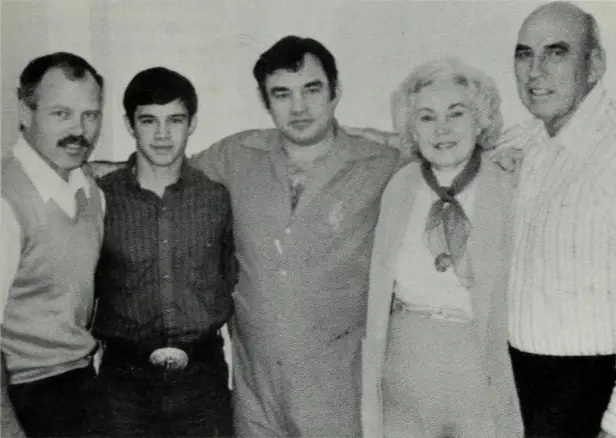
Bob’s brother, Gary, Bob, Bob’s mother and father
His appeals, which included a claim that he suffered from post-traumatic stress disorder (PTSD) from his service in Vietnam, were all unsuccessful.
After the trial, when Bob was given the death penalty, he and his family got a deputy to take their pictures. Bob insisted that they all smile.
Gary Black lived with Marjorie Eimann while he finished high school. In 1991, when author Ben Green interviewed him, Gary was attending Blinn College in Bryan. He was 21 years old, working, and had his own place. Today, Gary Black would be 56 years old, but I haven’t tried to look into his life today. I just hope he’s well and happy.
On May 22, 1992, seven years after the verdict, Robert Black was executed by lethal injection.
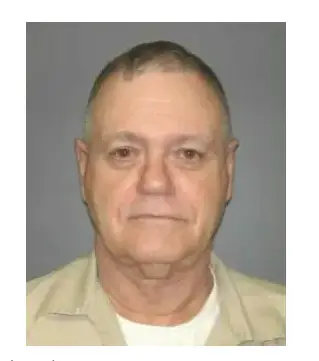
John Hearn in 2008
John Wayne Hearn had been in a South Carolina prison since he testified in the Black trial. That way, he was confined near his mother until she died in 2004. I have not determined if he is still alive, but I assume he isn’t since I can’t find him listed in South Carolina’s inmate search. If he was alive, he would be eighty-one years old.
Soldier of Fortune Magazine Lawsuit
Sandra’s parents and son sued the magazine in 1988 and won a $9.4 million verdict. A higher court reversed the decision.
Sandra and Gary said they decided not to pursue it any further. They mainly wanted to hold the magazine accountable and stop the classified ads for hitmen, which their suit had done. The family wanted to move forward. It was only after this and other similar lawsuits that Soldier of Fortune Magazine shut down its classified section.
Sources
The Eagle (Newspaper in Bryan, Texas)—articles from 1985.
The Soldier of Fortune Murders, Ben Green, an excellent book written in 1992. The book is out of print, but there are copies of it available on Amazon.
You can also read it at no charge after you set up a free account at the Internet Archive Library.
Credits for pictures: The photos shared in this video are not mine; they are from The Eagle newspaper and the book mentioned above. Illustrations were generated from ChatGPT.
mark
I was in Gary’s Boy Scout troop and knew him and his family. We stayed the night at their house. I was at her funeral and the sheriff was there. They were watching Bob.
mark
Another thing I remember is Gary didnt go to school that day but spent the day with his mom at her day care. So Bob went and got him and she went home to fix supper and Bob drove Gary around on his motorcycle while the murderer waited at the house to shoot her. He ransacked the house a little to make it look like a robbery and took a few pieces of jewelry if I recall. Then after a while Bob drove Gary back home and let him go in first to “discover” his mom. What a sick bastard to do that to his son.