

In the summer of 1972, a respected banker left her home in Washington, Indiana, to meet a client from San Antonio, Texas after hours.
She never came back..
Six months later, nearly a thousand miles away, three people were executed in their homes in the Texas Hill Country (Ingram, Texas). They were killed with chilling precision, nothing stolen, no witnesses left alive.
At first glance, the crimes appeared unrelated: different states, different victims, different circumstances. But beneath both tragedies ran the same dark current—money, deception, and a man who believed his debts could be erased if the people he owed were no longer alive.
That man was a decorated former Green Beret. This is a shortened version of the story in my currently FREE book, “Lethal Debts.”
If you are reading this on Facebook, the link to download it will be in the comments. If you are reading it on my blog, DOWNLOAD IT HERE or at the end of the article.
~~A Banker Who Didn’t Fit the Mold~~
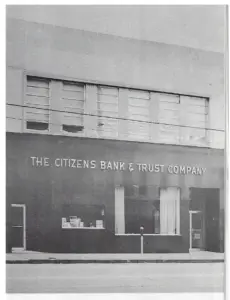
Citizens Bank & Trust where Beth worked.
Beth Carter was not supposed to be a bank officer in the early 1970s, but she was.
In small-town America, women rarely rose beyond clerical roles in banking, especially without a college degree. Yet Beth did exactly that. Starting as a stenographer at Citizens Bank & Trust in Washington, Indiana, straight out of high school, she worked her way up—earning trust, responsibility, and eventually the title of assistant vice president.
By 1972, Beth was at the top of her profession. She was also a wife, a mother of seven, and the steady center of her family’s life. Her husband worked long railroad shifts. Her children ranged from adults to grade-schoolers. Beth was the organizer, the problem-solver, the one who made everything run.

Beth Carter (Fictional Name)
Friends described her as dependable to a fault. Her employer trusted her completely. Her family relied on her for everything.
Which is why, when she vanished, no one could believe it.
On the evening of July 31, 1972, Beth told her daughters she was returning to the bank to finish some work. Earlier that night, she had spoken to a friend and mentioned she planned to meet a longtime bank customer who was in town.
That customer was Grady Thorn.
Beth drove away in her Oldsmobile Toronado, expecting to be home later that night, but she never came home.
~~Grady Thorn, Jr. was impressive on paper. ~~
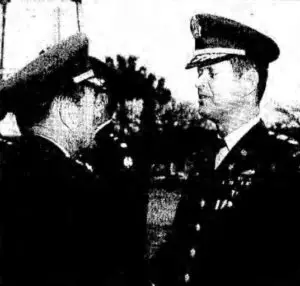
Grady Thorn Retirement Ceremony.
Thorn had driven from San Antonio to do business with Beth’s bank that evening. A native of Beth Carter’s hometown, Washington, Indiana, Grady Thorn had been a standout student and athlete before entering the U.S. Army. Over the course of a distinguished military career, he earned a Bronze Star with Valor, a Purple Heart, multiple Air Medals, and two Vietnamese Crosses of Gallantry. He served in Vietnam as a Green Beret, commanding dangerous operations and volunteering for high-risk missions.
By the time he retired in 1971, Thorn was respected, decorated, and outwardly successful.
But retirement did not bring financial stability.
After leaving the military, Thorn attempted to reinvent himself as an antique firearms dealer. It was a costly business requiring travel, inventory, and connections—and Thorn didn’t have the cash to support it. So he borrowed heavily.
From January through July 1972, Thorn accumulated tens of thousands of dollars in loans from Beth Carter’s bank. Beth approved the loans based on his history as a reliable borrower and the financial statements he provided—statements later found to be misleading.
On the very day Beth disappeared, Thorn received an $8,000 cashier’s check from the bank.
By the time the dust settled, Thorn owed more than $50,000.
And Beth had vanished.
~~A Disappearance Without Answers~~
At first, Beth’s family assumed she was traveling for work. In 1972, people weren’t tethered to phones, and Beth’s family (seven children and a husband) were also busy. A missed night at home didn’t immediately trigger alarms.
But when Beth failed to show up for work, and her car was found unlocked behind the bank, panic set in. Law enforcement launched an investigation, pulling in state police and eventually alerting federal authorities. They audited the bank. Nothing was missing—except that one check.
When detectives learned Beth had planned to meet Grady Thorn the night she vanished, his name shot to the top of the suspect list.
But Thorn was already back in Texas.
When the Indiana sheriff finally reached him, Thorn was unnervingly calm. He suggested Beth would “be back” and warned law enforcement not to be “too tough on her.”
It sounded less like concern and more like a threat.
Beth Carter was never seen again. Her body was never found. No physical evidence surfaced. Over time, the case went cold.
But Grady Thorn’s financial problems were just beginning.
~~Another Debt, Another Threat~~
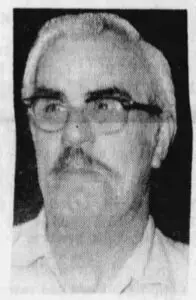
54-year-old JP Albert Kennedy, Jr.
In Ingram, Texas—a small Hill Country town near Kerrville—Judge Albert Kennedy, Jr. ran a gun shop and served as the local justice of the peace.
Kennedy was well-liked, fair, and known for his humor. He and his adult son, Thomas, ran the Texas Gun Shop together, selling firearms and extending consignment credit to collectors and dealers.
One of those dealers was Grady Thorn.
By late 1972, Thorn owed the Kennedys a significant amount of money for antique firearms taken on consignment. Judge Kennedy pressed him for payment.
Thorn refused.
He claimed he owed nothing.
Friends noticed Kennedy growing uneasy. Thorn’s behavior wasn’t just evasive—it was hostile.
Then, on the night of February 5, 1973, someone cut the phone lines to the Kennedy ranch.
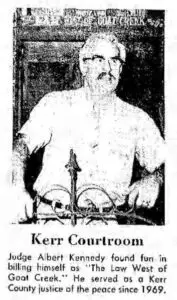
Albert F. Kennedy Jr., (1919-1972) the only photo currently available.
Judge Kennedy was shot during a violent struggle in his home.
Hours later, deputies responding to the scene discovered something even worse: The judge’s son, Thomas Kennedy, and his wife, Edna Gayle, had also been executed in their own home eight miles away. Their infant twins were found alive, asleep in their cribs.
Nothing was stolen. No forced entry. No witnesses.
The same .38-caliber revolver was used in all three murders.
~~A Pattern Too Clear to Ignore~~
Investigators quickly connected the dots. Beth Carter had been the last person to control Thorn’s access to money. Judge Kennedy had been the last person to demand payment.

Thomas Kennedy (1946-1972)
Both had confronted Thorn. Both were gone.
Thorn denied everything, invoking his Fifth Amendment rights repeatedly. He produced documents marked “paid in full” in Beth Carter’s handwriting—documents that conveniently surfaced after her disappearance.
Once again, the person who could contradict him was unavailable.
The case against Thorn tightened. Law enforcement believed it was only a matter of time before he was charged.
That time never came.
In June 1973, before he could be arrested for the Kennedy murders, Grady Thorn died by suicide.
He left behind unanswered questions, shattered families, and a trail of devastation stretching from Indiana to Texas.
The full book dives deeper into original reporting, financial records, trial documents, and newspaper accounts to reconstruct these events with care and precision. Names were changed where necessary, sources are meticulously cited, and the focus remains where it belongs: on the victims.
Some debts can be paid.
Others come due in blood.
If you want the complete story—the details that couldn’t fit here, the documents, the timelines, the unanswered questions—you can download and read the 99-page story of Lethal Debts in full.
Questions or comments? Write me at vintagetexascrimes@gmail.com or send me a message on Facebook.