
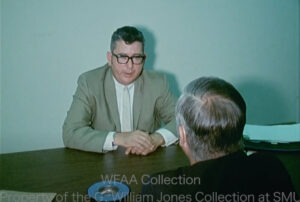
The man facing the camera is a lawyer named Leon Cordell Horton.
Go to Declared Dead in Dallas County Plus+ (in progress now) for more pictures, documents, and videos from the story.
I didn’t decide to write Declared Dead in Dallas County. The story decided I would write it.
I just happened to brush up against it one afternoon. After that, I couldn’t get away.
For several years, I wrote web content weekly for various notary websites. One Sunday afternoon in early 2020, I went looking for old newspaper stories about dishonest notaries public in history.
I came across an article entitled, “Grand Prairie Notary’s Fourth Arrest.”
That story hit me like a hard drug addiction.
The case was a little like the Alex Murdaugh case in that the bad guy was a lawyer.
A Dallas attorney named Leon Cordell Horton went really bad, and he took along a carpet salesman named Ardis O’Dell Reed to help him.
Ardis got a Texas notary commission so he could help forge documents, and the two of them set out to steal money and property from folks who had gray hair and plenty of liquid assets. This pair of clowns just decided to grab what they wanted, and the cost to others didn’t matter.
Their victims “went on a little trip” leaving Leon Horton in charge of their money and property.

There was a good bit of real estate fraud involved, the same kind of fraud we see today, except in the 1969 story, at least three victims disappeared and were never seen again.
Horton and Reed chose their mark splendidly the first time.
Landlady Anna M. Farley didn’t have any family around to know or care that she was gone.
They dismantled her assets quickly. It went so well, they went after another senior citizen without visible means of family support around.
The old guy’s name was Robert L. “Tex” Roberts.
As I learned about Tex, I formed a picture in my mind of Andy Griffith. But not Andy as Matlock–Andy as he was when he played the diabolical aging wildcatter, Ash Robinson in a made-for-tv movie, Murder in Texas, back in 1981. The old man thought his physician son-in-law, Dr. John Hill, had poisoned his only daughter and the light of his life, Joan Robinson Hill. (And Hill had a girlfriend. He probably did poison her.) But Ash turned around and had John Hill killed, too. There was a trial. (I don’t want to spoil it if you haven’t heard about this one, so I will stop.)
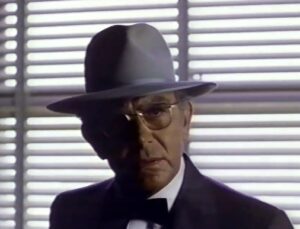
Photo of Andy Griffith playing Ash Robinson in a movie, “Murder in Texas.” The murder happened around 1969 in Houston. The movie came out in 1981.
Anyhow, Ash Robinson was very rich and very difficult. Tex Roberts was also rich and difficult. He was probably not as rich as Robinson, but likely more difficult, and Tex’s family couldn’t stand the sight of the old man.
Tex Roberts claimed to have been a mercenary during WWII, and a spy, and claimed he worked against unions in Detroit after WWII. There, he became friends (maybe more?) with a woman about ten years older than he was.
Her name was Jessie I. Forsyth.
She was about 81 in 1961, an infirmed ward of the State of Michigan, and had no in her life except Tex Roberts. She also had assets, and this is probably more than anyone wants to know in a blog post, but Jessie had been in a nursing home in Michigan just three years before she went missing. In 1961, Tex Roberts put $25,000 in an account for her alone to show he could take care of her and convinced the state she was his sainted dead mother’s sister. [Note: $25,000 then is like $250,000 today.]
The State of Michigan finally let Jesse go to Texas with Tex.
When Leon and Ardis found Tex Roberts, they thought they had hit the lottery, but they didn’t do their homework. If they had, they would have known Tex Roberts had a good friend who cared about him. Al Bergeron, a tv repairman, wouldn’t leave it alone when Tex and Jesse went missing.
I spent so much time researching this story that I started feeling ridiculous.
The landlady, Anna M. Farley, a victim I mentioned earlier, started living in my head rent free. I could barely carry on a conversation without mentioning Anna, Tex, or Jesse.
Why couldn’t I quit thinking about it? I didn’t know any of the people in it, but the old folks reminded me so much of my stepdad, Harvey, a partially disabled WWII vet whom I had admired, and whose life had not been so different from the three victims. Finally, I reeled myself back in, thinking, “Move on! No one but me and probably two other people care about this evil lawyer, all his forged paper, and this notary.”
But the story had everything from an imaginary secret agent who wore ruby ring, to someone claiming he saw Jack Ruby and Lee Harvey Oswald together. There were political conspiracy theories involved, and the story happens in different places around the state: Amarillo, East Texas, downtown Dallas, and even Highland Park.
So I made myself quit pursuing it. It was a waste of time and I was sure no one else cared about, until one day it found me again. I read about it in a short article in a near-50-year-old issue of Texas Monthly.
The article mentioned Dallas lawyer, Leon Horton, his notary accomplice, Ardis O’Dell Reed, and their victims, a millionaire named Tex Roberts, his companion Jessie I. Forsyth, and a landlady from Dallas named Anna M. Farley.
“Wait a minute,” I said to the dog, “If Texas Monthly thought it was a worthwhile tale in 1976, maybe I am not the only one who will be interested after all.”
In his infinite wisdom, the dog said, “I think you ought to write it.”

Hank
So I wrote and finished it; and the first draft was a hot mess. So I rewrote it, and that version was a mess. I went after it again, and it was awful….so I wrote it again, and I hated it, but I let it “cool off” for a few months. It’s not quite as awful as I thought before. I think I can make it work. It’s my fourth or fifth round, so maybe I’m getting closer.
If I had tried to do this when I was young, I would have been mad when I didn’t do it perfectly the first time. That would have been the end of me writing anything. But I’m more patient now with myself, and I don’t care so much what other people think.
It’s my first book, and I’m no Ann Rule or Joe McGinnis, and I won’t ever be. But if no one likes it, my world will be perfectly fine, because I love it, and that’s really the kind of writing to do. If you are thinking about writing, you had better love the story you are writing because you’re going to be living there a long time.
(Oh! If you are going to write, keep in mind, haters are going to hate, but my kitty, Pearl, told me, “Fluff the haters!”)

Find her at #pearldaily on Reels/FB
Whatever comes, I’ll roll with it.
I’ll learn from it, and move on to write the next one…but actually, I’ve already got that one almost finished, too.
This summer, while Declared Dead in Dallas County was in the cooler, I began writing Unlikely Victims. It’s a story that made me think about how a person can simply be in the wrong place at the wrong time. This true tale is about two good, kind, and sincere college girls (Susan Rigsby and Shirley Ann Stark) who were killed by a “friend” on July 18, 1965 in Austin. They interrupted him on a day he was watching a baseball game. He invited them in, and they never left. The photos, maps, and documents to go along with Unlikely Victims will be at this link.
That was another story I couldn’t shake off once I knew about it. So, I decided to make that into Book Two. I hope for both of them to be published before December 31, 2024. I have made a page with pictures, videos, and maps to accompany Declared Dead in Dallas County will be linked right here while I am working on it.
I am looking for 10 early readers to critique my books and send feedback to me before I publish them.
Each book is 175-250 pages, so not too much of a commitment, I hope.
Fill out the form here: ARC Form .
I can mail you a paper copy or email an EPUB or PDF.
Or you can contact me via email: vintagetexascrimes@gmail.com. Or text me: 979-217-2589
Best, B.K. Smith