

1991 Murder of Edwina Prosen in Sweeny, Texas
The little town wasn’t stirring yet. It was a Sunday morning, the last one of September 1991, and a man was sitting on a bench.
The bench was in Sweeny, Texas, a town with a population of 3,921 in 1991. If the term “bedroom community” needed a model, Sweeny could be it. The little town was next door to the Phillips 66 Refinery (now the Chevron Phillips Chemical Sweeny Complex).
That morning, the only hubs of activity were the usual suspects for a small town—a gas station or two, a breakfast taco stand, maybe a donut shop, and the refinery, of course.
There was no traffic to speak of where the man sat … just a quiet street, one block off of Main Street. The bench was in front of the funeral home, by a lone grave. The stone bench had been carved from rose granite.
The man was clad in his pajamas, a bathrobe, and house slippers. Beside him lay a folded newspaper. And if you believe his story, nearby, a shotgun rested within his reach. He said he had it out there because he was going to shoot it in the air to scare off some mean dogs pestering his own, a pair of Akitas.
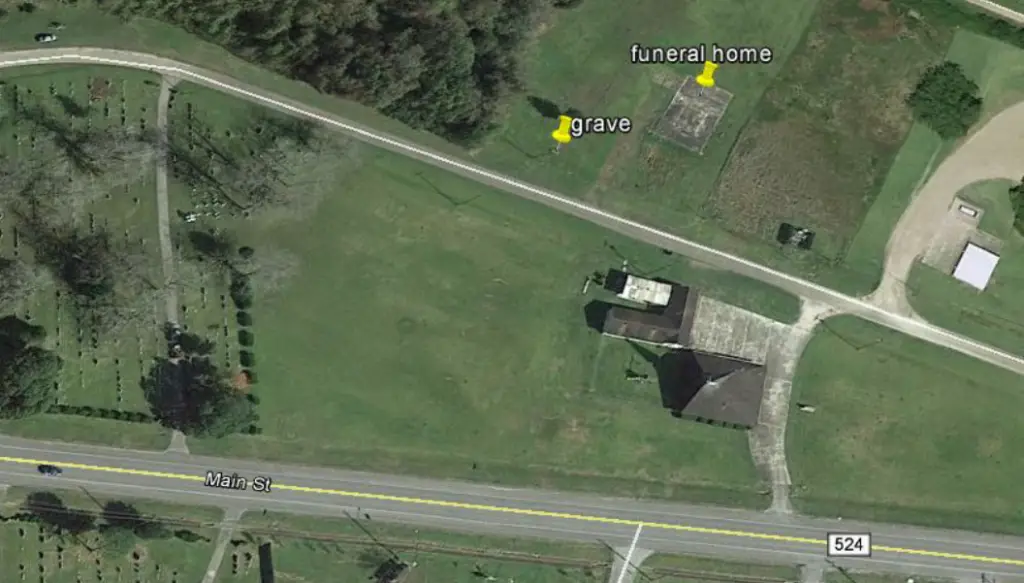
Former Site of Sweeny Funeral Home
—– —–
Hi, it’s Brenda from Vintage Texas Crimes. Thanks for the likes and for following this page! I truly appreciate it.
I am sorry there are no pictures of the victim in this story. There just aren’t any. I looked for hours and found nothing.
—– —–

Former Site of Sweeny Funeral Home (Note the grave of Johnson’s son is still there.)
The man on the bench was Jay Herman Johnson, a funeral director who had spent decades tending to the dead. The bench he sat upon marked the grave of his teenage son, killed in a car accident nine years earlier and buried—illegally, you could say—right on the city’s easement. The grave was between the funeral home business and the street; it was almost like an advertisement for the funeral home that sat behind it.
Johnson would sit out there and talk quietly to his son’s grave often. I guess if it had been in the back, in a cemetery, or in a more private area, no one could see the grief he poured out daily … and it seems like maybe Johnson was one of those people who figured if someone didn’t see you grieving, were you even grieving?
Of course, I don’t know much about this man, just what the newspapers have said. I met him once, and I have drawn a few conclusions from what I have read.
His explanation is that he stood up that morning after sitting on the bench and “talking” to his son at his resting place.
I realize I am jaded, but this seems to be a planned-in-advance play for sympathy. Anyhow, Johnson picked up his newspaper and carried the shotgun upstairs to the apartment on the second floor above the funeral home and offices; it’s where he and his partner, Edwina Prosen, lived. Johnson told the police he was going up to make a pot of coffee.
Something happened; only Johnson’s version remained to say what.
Minutes after the man left the bench, Edwina Prosen was dead. He had shot her—that much he admitted, but he said it was an accident … but was it? Or was it murder?
Johnson would have more than one version of the shooting of Prosen as time went on. That morning, he said he had walked into the bedroom where Edwina was asleep when he got a leg cramp.
He told the police that his shotgun had fallen onto the bed and discharged. But here’s the weird thing: Johnson said he next retrieved a body stretcher from his hearse and tried unsuccessfully to move Prosen down the steep plywood stairs.
We can only wonder what his plan would have been if he had managed to get her down the stairs!
After that, he called the police, sat on the bed, and cried, he said.
From there, the shooting on September 29, 1991 was a murky mess that became a legal maze over the next decade.
Edwina Prosen was a force in life. She was 57 years old when she died, but she had already lived several lives by then. Edwina was cultured and graceful; she spoke French and played the piano.
She was born in Queens, New York, to a Swiss chef, Eduardo Reuter, and a first-generation Sicilian-American mother, Mary Accuso Reuter.
In the 1950s, Edwina married a man named Sidney Prosen, who fathered her three boys. Sidney was in the music business. It’s no wonder she had fallen for him. Things went well for a time, but the bottom fell out when Sidney hit hard times and refused to lift a finger to support the family financially.
Edwina felt she had no choice, so she left with her three boys, who were still in elementary school. Neither Sidney nor Edwina bothered to file for divorce for over a decade. Edwina took the boys and just left.
Whip-smart, Edwina found a job right away; so did her oldest son, Phillip. She worked as a secretary and a teacher’s assistant. Phillip delivered newspapers. Later, the younger boys, Robert and Jeff, entered the odd-job workforce, and the young Prosens learned early that families survive by pulling together. Edwina’s sons would later remember evening meals at the table because their mother insisted they sit down together and eat.
They would remember Boy Scout meetings with her there, Edwina’s piano music drifting through their home, and a mother who insisted on being present—even when life made it difficult. Edwina was a wonderful force of nature to her sons.
When her sons grew older and scattered to college and careers in Texas, Edwina followed them. She moved from Queens, New York, to Houston in the mid-1970s. There, she took jobs in oil company offices and in hotel conference planning. The New Yorker had started over in a state she had never imagined would become home.
While working at a hotel conference position, she met Jay Herman Johnson, and he really laid it on thick.
The Funeral Director
“Coming to No Good End” by George Flynn, an article that appeared in the Houston Press on May 13, 1999, served as the primary source for this post. Flynn did a magnificent job covering this long story in his ten-page article. (I will link it at the bottom or in the comments, depending on where you are reading this. It is a great read.)
Flynn summarized Johnson up like this:
“If death is an enigma, so was the man who had made his living from it. Forty miles south of Houston, debates still flare occasionally in Sweeny cafes as the locals share the lore that has been built up about Johnson and, in some cases, by Johnson himself.”
A native of San Antonio, he served a short stint in the Navy during the Korean War era. Johnson later claimed elite military missions—I heard that nonsense with my own ears the one time I met the man.
According to Flynn, Johnson boasted of advanced college degrees that did not exist, and he padded his resume with lies.
The truth? By my standards, he had no reason to make up big stories. Johnson was hardworking, and he had obtained a GED while he was in the Navy. After the Navy, he had worked as a truck driver, an embalmer’s assistant, and eventually became a licensed mortician in Texas and Louisiana. And there’s not one thing wrong with that career path. It is admirable. The problem was that he had lied about his past when the truth would have worked better.
When Johnson needed a job and wanted to go to work for Dow Chemical, he applied and was chosen for a job as a night operator after boasting of a Northwestern University master’s degree that he did not have.
In a civil lawsuit in the 1980s, Johnson testified he had Northwestern University (Illinois) degrees in chemistry and bacteriology. In the 1990s, during his legal troubles relating to the fabrications , he was asked about them; Johnson said, “I guess now looking at it, I don’t have any reason for having said all that.”
By the 1970s, Johnson owned the Sweeny Funeral Home and later expanded—buying additional funeral homes, a monument company, and property in multiple Texas towns. He was tall, intimidating, aloof, and widely regarded as a hard-nosed businessman.
People in Sweeny noticed Johnson did not care about rules.
The burial of his teenage son in 1982 put off a good many people, Johnson claimed the body and buried the boy directly on a city easement—without a waiver or permission to do so. City officials were appalled. But the people in Sweeny aren’t monsters, and no one forced him to move the grave.
Johnson answered to few authorities.
He surrounded himself with firearms, dogs, recording devices, and control. He was not known for warmth, but he was known for efficiency. Johnson drained a body of its blood, prepared it for burial, rinse and repeat. He had done it more than a thousand times.
To Johnson, death was a business.
A Partnership—and a Trap
Edwina was drawn to Johnson’s world in a way that surprised her sons.
He convinced Edwina that he was prosperous. He convinced her that his businesses were stable investments that produced a great income. And eventually, he convinced her to join him.
At his urging, Edwina enrolled in the required courses and earned her mortuary and funeral director licenses, no small feat for a woman reinventing herself in midlife. She became director of the Sweeny Funeral Home—the licensed professional Johnson increasingly depended upon.
They lived first in Houston, then in Sweeny. Edwina fell in love with the country—the quiet, the trees, the wildlife. Her mother moved in after her husband died. Her youngest son, Jeff Prosen, had lived there as well.
Everything looked good to the outsiders looking in, but by the late 1980s, Johnson’s financial world was collapsing. State regulators revoked his funeral licenses. He was fined for overcharging families and operating unlicensed facilities. One funeral home was shut down entirely. His monument company burned in a suspicious fire shortly after he increased its insurance coverage.
Banks were calling: Johnson’s loans were overdue, and foreclosure loomed. And Edwina—licensed, competent, respected—was keeping the funeral business open.
Edwina’s Fear
Arguments escalated between the couple. Johnson installed an elaborate phone-recording system. Some tapes captured shouting, screaming, verbal abuse. Friends said Johnson still called Edwina his “baby,” but the recordings told a harsher story.
Edwina’s sons noticed changes, and she confided she was afraid of Johnson. She had purchased a handgun shortly before her death. She told her sons she planned to leave Johnson—but only after handling the business matters that tied them together.
One of those matters was insurance. Edwina mental “to do” list had “change beneficiaries asap” on it, and she was planning an exit, and the time of exiting is the most dangerous moment of a bad relationship.
Between them, Johnson and Edwina Prosen carried more than $300,000 in life insurance policies, many with double indemnity clauses that would pay out significantly more in the event of accidental death. When Edwina died, Johnson stood to receive $675,000 in insurance if Edwina’s death was ruled an accident. And he had recently added a policy through the National Rifle Association. He had also asked about million-dollar whole life policies only months earlier, but the insurance agent was uneasy about it and never called Johnson back.
Eleven days before Edwina died, Johnson checked to be sure that one of the insurance policies would pay off her Cadillac if she were killed.
The “Leg Cramp” Defense
Johnson held onto his story that morning, that he had grabbed the shotgun on the way out to scare away a neighborhood dog bothering his prized Akitas.
And he repeated that his leg cramped when he stepped into the bedroom—the gun fell, discharged, and struck Edwina as she slept, and he had cried.
Edwina’s mother, Mary Reuter, awoke to the blast and ran to the bedroom. She touched her daughter’s face and felt the cold already setting in. When Johnson appeared carrying a stretcher, she looked at him and said, “You murdered my daughter.”
Police arrived. Johnson followed the ambulance to the hospital. He waited until Edwina was pronounced dead. Then he began acting like a man with business to attend to.
A Body Taken
The next day, Johnson was a man with purpose. He stopped first at his financial adviser’s office to discuss foreclosure negotiations.
Next, he saw a lawyer. If small-town gossip is to be believed, he dropped in on the lawyer to see about getting control of an elderly woman’s estate; she was on his slab at the mortuary. It is not uncommon for funeral directors to do that when there is no next of kin. Otherwise, they won’t get paid for handling the remains.
Now, the lawyer he saw never officially said this on the record, but whisperings among the legal community suggested Johnson never said a word to him about Edwina’s death that had happened the day before.
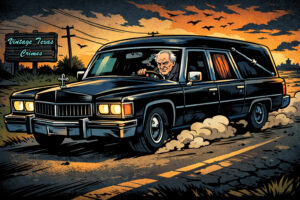
Jay Johnson stole Edwina Prosen’s body.
Authorities had refused to release Edwina’s body to Johnson. Her sons, as next of kin, did not want him near her remains. Edwina’s body was transported to the Harris County morgue.
Sometime after he left the lawyer’s office, he drove his hearse to the morgue and took possession of Edwina’s body anyway—ignoring an order from a justice of the peace.
The sheriff’s department got word he had her body, and a Brazoria County deputy, Frank Cisneros, stopped the hearse on the road. Inside was a body bag containing Edwina Prosen—and stacks of insurance paperwork.
Johnson was arrested, and for a brief moment, it looked like Edwina might get the justice her sons believed she was due.
When Evidence Becomes the Enemy
The Prosen family cleared out the living quarters behind the funeral home.
They found altered IDs, insurance documents, and false social security numbers. They turned everything over to the police. The decision to do the cleanout unraveled the case against Johnson.
Defense attorneys argued the evidence was illegally obtained. A judge agreed. Nearly all insurance-related evidence was excluded as “fruit of the poisonous tree.”
In the end, Bass barred almost every insurance-related piece of evidence. The state appealed, clearing the way for Johnson’s release from jail under rules guaranteeing him a speedy trial.
The prosecution’s theory of motive collapsed.
What about him stealing the body? The judge threw that out, too. They should have waited for a search warrant … didn’t have the right to stop and search him … I think the judge got some of this wrong. So did the prosecutors, but the appeals court agreed with the judge.
Appeals crawled through the courts. Years passed. Johnson was declared mentally incompetent to stand trial. He was diagnosed with major depression and paranoid personality disorder. His son became his guardian.
When the case finally went to trial in 1997, jurors were shown a reconstructed bedroom—so they could think about how it had happened. But they were not told about the life insurance policies, Johnson’s financial desperation, or the theft of Edwina’s body.
The jury convicted Johnson not of murder, but of negligent homicide.
He had already served more time than the maximum sentence, and he walked free.
A Son’s Breaking Point
On April 21, 1997, Jeff Prosen went to a VA hospital in Houston to pick up medication.
In line, he saw the man accused of killing his mother. Jeff swears that he saw Johnson staring at him then flash a grin and a wink.
Jeff made a big, but understandable, mistake. He went to his car and got his Glock. He found Johnson outside and forced him to kneel at gunpoint in a public space crowded with veterans. David Burke, the VA police chief, talked Jeff down.
Johnson had wet himself by the time it was over.
Jeff surrendered. He later pleaded guilty to aggravated assault and received probation.
The man who killed—or accidentally killed—his mother never apologized.
Civil Court: The Only Place Left
The Prosen brothers turned to civil court.
There, the insurance evidence finally came in.
Experts challenged the accident theory. Jurors watched Johnson testify—cold, detached, unmoved. The case was settled before the end of the trial when Johnson agreed to give up all rights to the insurance proceeds, nearly $900,000 with interest.
The Funeral Home Today
The Sweeny Funeral Home is gone. For years, it stood there rotting away, with shattered windows and weeds choking the driveway. A battered hearse was sinking into the mud behind it.
Only the grave out front remains tended. The rose-granite bench is inscribed thusly:
The past is gone.
The present is lost as it arrives.
There is only tomorrow.
And tomorrow waits for no one.
SOURCES – Links will be in the comments on Facebook.
George Flynn, Coming to No Good End, May 13, 1999, Houston Press.
https://www.houstonpress.com/news/coming-to-no-good-end-6567321/
I highly recommend that you read this detailed, lengthy article if you are interested in this story.
PHOTO CREDIT: The pictures of the area where the funeral home was located on my blog post were on Ancestry dot com, submitted by “basil_shannon1” in 2015.